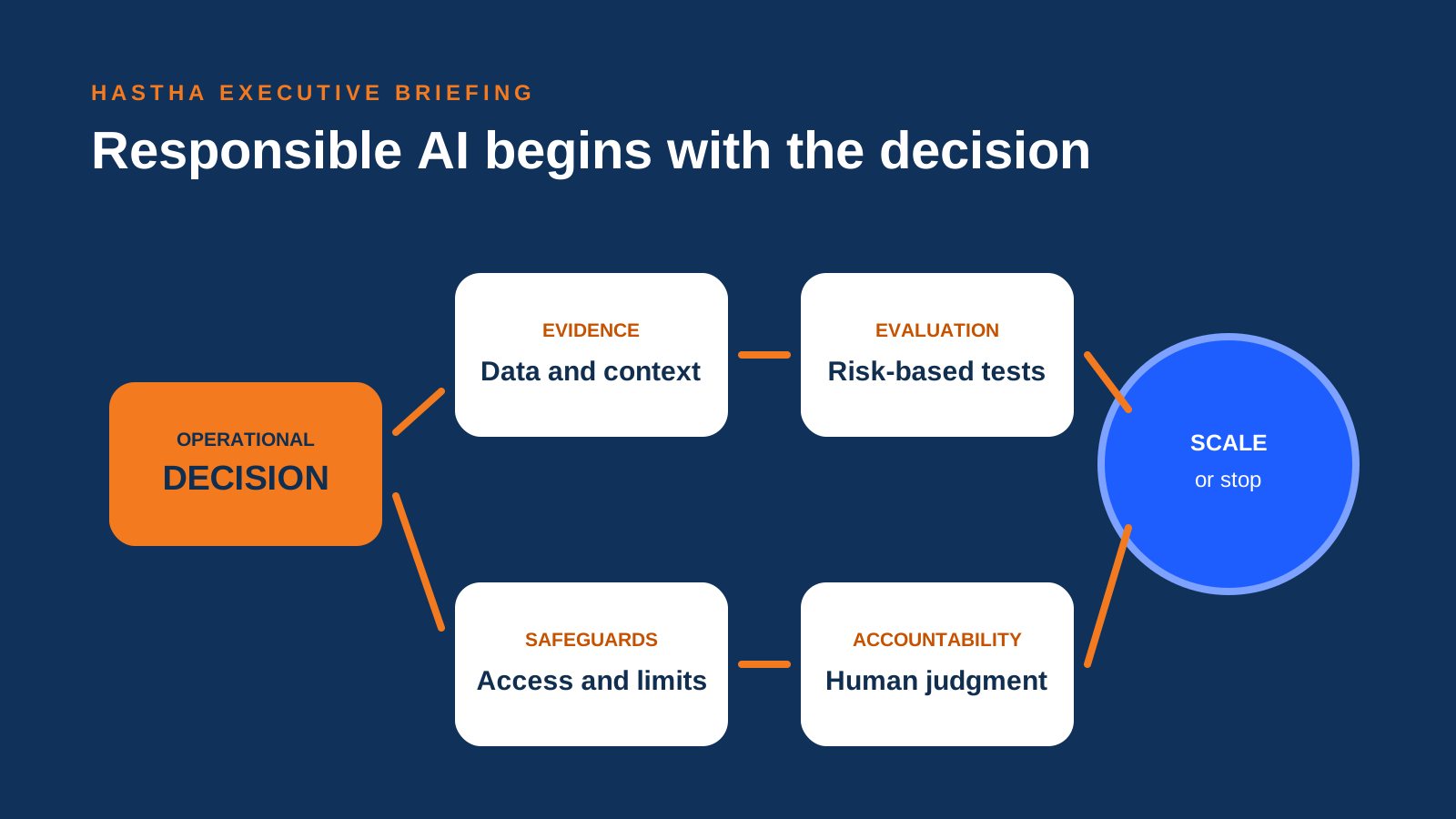
Asset operations contain many attractive AI opportunities: finding technical knowledge, improving data quality, interpreting inspection evidence, predicting failure, recommending work and helping teams plan. The risk is beginning with a model or platform and searching for a problem that can justify it.
Start with a defined task or decision. Identify who uses the result, the available information and the consequences of an error. Agree what a person must review or approve before selecting an AI technique and architecture.
Frame a decision, not a broad ambition
“Use AI to improve maintenance” is not testable. “Help a planner identify work orders that are missing the evidence required for weekly scheduling” is. The second statement names a user, decision window, information set and measurable effect. It also makes clear that the planner remains accountable.
Describe the current decision, delay, error or effort. Quantify enough baseline to judge change. If the use case cannot identify a user action and an observable result, it is not ready for a proof.
Match the technique to the evidence
Different use cases require different methods. Knowledge assistance may use retrieval over governed procedures. Data-quality support may combine deterministic rules with probabilistic matching. Failure-risk estimation may require statistical or machine-learning models with engineering features. Generative AI is not the default answer to every information problem.
Assess whether the available data represents the decision. Work-order history may encode inconsistent failure reporting and changing maintenance practices. Sensor data may cover only a subset of assets. Technical documents may have access restrictions or conflicting revisions. The proof should surface these limits rather than hiding them behind a fluent response.
Design human accountability explicitly
State what the system may recommend, draft, classify or automate and what remains a human decision. Define when the user must review evidence, when the system must abstain and when escalation is required. High-consequence actions need stronger controls than low-risk administrative assistance.
The interface should show the basis for a recommendation in a form the user can assess. That may include cited documents, contributing measurements, confidence, data age or rule triggers. Explanations should support judgment rather than create a false impression of certainty.
Named accountable role for the final operational decision
Clear boundary between suggestion, approval and automated action
Abstention and escalation conditions
Evidence visible at the point of review
Audit trail of input, output, user response and model or rule version
Evaluate against the operating risk
Accuracy is rarely one number. Evaluate false positives, false negatives, coverage, consistency, calibration and user interpretation. A maintenance triage tool that misses a critical risk has a different cost from one that creates extra review work. Set acceptance thresholds with operational and engineering owners.
Use representative and challenging cases, including incomplete records, unusual assets, contradictory evidence and out-of-distribution conditions. Compare against the current process and a simple baseline. A complex model should earn its additional cost and governance burden.
Build the control environment with the proof
Security, privacy, access control, data residency, prompt and output handling, third-party terms, monitoring and incident response are part of the design. Retrieval must respect source permissions. Logs should support investigation without unnecessarily retaining sensitive information.
Define the approved model and data path, change process, evaluation suite and operational owner. If the proof succeeds, these artefacts become the beginning of a production control environment. If it fails, they explain why and prevent the same experiment being repeated without learning.
Make the scale decision evidence-based
A proof should end with one of four decisions: stop, refine, deploy narrowly or scale. The decision should consider operational value, user adoption, model performance, risk, integration effort, ongoing cost and support capability. Demonstration quality is not production readiness.
For approved use cases, plan monitoring for data drift, changing procedures, user overrides, incidents and value measures. Assign ownership for the model, business process, data and technology service. Responsible AI is an operating discipline, not a one-time review.
Start where evidence and accountability are strongest
The best first use case is not necessarily the most dramatic. Choose a valuable decision with accessible evidence, a clear owner, manageable consequence and a realistic baseline. Knowledge retrieval with citations, data-quality triage or planning support may create more durable value than premature autonomous maintenance decisions.
Beginning with the decision keeps technology in proportion. It gives leaders a credible way to test value while preserving the human accountability that asset-intensive operations require.